Saturday, March 30, 2024

Semana Santa, Oaxacan Style


 Judy. Having experienced Semana Santa (Holy Week) in the elaborate style of Andalucía in Spain, I was curious to see how Oaxacanians would honor this holy Catholic observance. Wow! While they have hints of each other, they are quite different.

In Oaxaca, joy and celebration seem to permeate everything everywhere.There was a Carnival parade before Lent, but nothing changed afterwards. Weddings (and this is a spot for destination weddings) held at Templo Santo Domingo call for bands, parades, Indigenous dancers, and mezcal. I thought during Lent, the forty days before Easter, we would see a slowdown, but nothing changed--there were still two or three weddings every Saturday. 

As Palm Sunday approached, a flyer appeared describing the events of the week. Pretty darned quiet. Around the churches, elaborate sculptures made of palms appeared, which were taken to the church to be blessed and, after Palm Sunday, kept at home.

Hotels and restaurants decorated


Elaborate weavings from palms


During the week, several concerts are held in different churches. Music pervades everything here.

"Stabat Mater Doloroso" performed at Basilica de Soledad

As in Spain, the two stars of Holy Week are the Christ figure and the Mary figure. And, as in Spain, Mary gets a great deal of attention. Also, as in Málaga, there are many churches in town.

When I first arrived here, I was surprised that I didn't see more of Nuestra Señora de Guadeloupe. She's definitely tucked in the corner of the dozens of churches, but, like the gold trim in these fancy worship centers, a more elegantly dressed Madonna is called for. You can really see Spanish influence here!

The most prominent, Nuestra Señora de la Soledad, is housed in the Basilica that is named for her. She is dressed in black, with gold embroidery attaching 600 diamonds, as well as pearls, to her robe. Her crown is made of four pounds of gold, and a large pearl dangles onto her forehead. This is the Queen of Oaxaca who is paraded through the streets on special holidays. Well, her body double is. Soledad and her diamonds and gold stay behind a window on the altar of the church. She reigns in Oaxaca city.
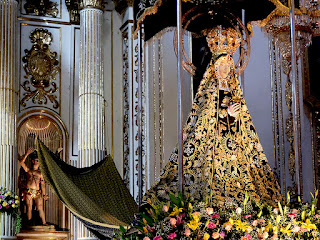
Nuestra Señora de Soledad (internet image)

Legends of her arrival vary, but basically the story is that in the seventeenth century (about the same time Guadaloupe appeared further north) an unattended burro showed up and keeled over dead. When the people unwrapped his burden, Soledad was there. By the end of the century, a cathedral, now a basilica, was built to house her.

On Holy Tuesday, a Procession of Banners marches from the Basilica to the Cathedral, and back again for an outdoor Mass. Unlike in Spain, the men carrying the banners and reliquaries of the Confraternity of Antequera (Oaxaca) Diocese are often teens, dressed in t-shirts. Several men carry a trono with the suffering Christ figure, and Soledad, His mother, waits for him at the church rather than be paraded with him. This is the first of two main processions of the week. Much simpler than southern Spain.

Altars along the route

Christ figure

Banners after arrival at the Basilica courtyard

Soledad (body double) awaits


To the southwest, in another pueblo of Oaxaca State, is another Madonna, Virgen de Juquila. While Soledad is life-sized, Juquila is much smaller, at 30 centimeters. She was brought from Spain, and the friar who carried her gave the figure to his servant, who set her up in his house, where she was venerated. She was given responsibility for so many miracles that the priest in Amialtepec thought she should be moved to a church. But the church caught on fire, and the only thing to survive was the tiny statue of the Virgen. The villagers tried to clean the burn from her, but she became, like them, and like Guadeloupe, a representation of their own dark skin. Then the priest decided she should be moved to Juquila. But she returned to her little village every time, and was finally allowed to stay. Many people walk a pilgrimage to see her and ask for miracles, and, I'm told, at Easter, the tiny town is packed. Near our apartment there are buses that take the pilgrims to see her. 

Virgen de Juquila (internet image)


Signpost on pilgrim way to Juquila


Buses take pilgrims unable to walk


Both of these Marys have their own feast days, but Easter is a very special time for them.


On Good Friday morning, there is a silent procession of pictures representing Christ's passion, carried from church to church in the Stations of the Cross, then left in the Cathedral.

Banners from different churches and confraternities reside in the Cathedral


Malága's Holy Week means procession after procession for the full week, with the confraternidades in their  costumes and masks, a tradition that goes back to the Middle Ages. 

Màlaga Confraternidad, one of dozens


Only costumed Confraternidad in Oaxaca procession


Here, there are touches of the tradition, but done with dignity in Oaxaca's own way. And there is only one major procession on Good Friday.


And unlike the elaborate tronos of southern Spain,the holy figures and banners here are carried by locals, including children. The Solemn Procession on Good Friday was silent, with only a drum beating. The crowd stood by; not a word was said. It was deeply moving.


Virgen de Los Dolores is carried from San Tomàs de Xochimilco

This young boy and his abuela took turns with this banner

Women from Familia Valera 

Penitentes carry crosses the whole way

As different as the two celebrations are, they speak to the parts of the countries they represent. Spain is in so many ways more formal, but much of its riches came from the silver and cochineal of this corner of Mexico. And in return, Spain has clearly left its mark on this Mexican state. Each, in its own way, honors a sacred event. I feel blessed to have experienced both of them. If you would like to read my post from Málaga, visit the blog archive for April, 2022 titled Semana Santa.


Sunday, March 24, 2024

On the migrant trail

Ted. A quick look at this map reveals the primary routes being taken by thousands of migrants from Central and South America who are crossing Mexico on their way to the US.


This is something we have not seen before, and it is shocking!

I don’t feel the need to discuss the politics or the economics behind what is taking place. The reality is that we see dozens of migrants every day as we walk our neighborhood. They rest in the parks, panhandle along the sidewalks and sleep wherever they can. 

The locals are not used to this either. I have seen some Oaxacans giving coins to the migrants with children but have also heard that there is a degree of resentment and even racism, as South Americans look and speak differently. 

Judy and I volunteer with a local group called Collin A.C. Migrant Support. These folks gathers each day to prepare and distribute 200 lunches plus diapers and hygiene items to the migrants. They hand out clothes and have established a very popular cell phone charging station. 

These young travelers (and they are all young) face starvation, disease, robbery and rape as they trudge along. Yet they are determined to achieve their goal of a better life in the US. They are truly grateful for small acts of kindness and welcome the chance to practice their English - even if it is just a quick “Thank you” for the sandwich. 

I am reluctant to take photos of people without permission. However, if you visit OaxacaMigrantAssistance.org you can see lots of images and learn more about the efforts of this organization. Here is my favorite image from their photo gallery:


Sunday, March 10, 2024

Community owned forests

Ted. The Oaxaca Lending Library (oaxlibrary.org)  is a organization that serves the expat community in Oaxaca.  A few weeks ago, Judy and I attended a talk there by a retired professor named David whose topic was the community owned forests of Mexico. 


Most forests around the world are owned by governments, large corporations or individuals. However, 60% of the forests here are owned and managed by local communities which are typical indigenous peoples.


Over the years, we have learned a bit about forest management from Judy’s brother who is a tree farmer. Naturally, we were curious to learn how a community could do this. 


After the talk, we met up with David for lunch and he told us more about this fascinating concept. After chatting for a bit, David asked us if we’d like to actually visit a community owned forest and meet some of the people. Of course we said yes!


This week, we joined David, journalist Linda and her friend Jane on a two day excursion to Ixtlán de Juárez, a small town in the Sierra Norte de Oaxaca, a mountainous region about 40 miles north of the city of Oaxaca. 


This is a Zapotec community and the folks here are fiercely proud of Benito Juárez, a poor local boy who grew up to become president of Mexico in 1858. We were told that until 2006, Juárez was the only indigenous person to have ever been elected president of a country.


Upon entering Ixtlán, the first thing we saw was a sign informing us that we were in an unusual part of the world.


Translated, it says:


“In this community there is no private property. The purchase and sale of communal land is prohibited.”


Several decades ago, the people in this area were scraping by as subsistence farmers so they were thrilled when the federal government gave them ownership of their forest along with infusions of capital and training. This has happened in about 60 other forests around Mexico and Ixtlán has become a great example of how it can work.


The locals enjoy several revenue streams from their precious resource. They harvest timber using sustainable methods that guarantee the forest will be even healthier in the future. In the photo below, the light patches on the mountainside are new growth forests that arises naturally after a harvest.


They operate their own sawmill.


Ted, David, Judy, Linda & Jane


They have their own furniture factory where 60% of the employees are women.


I thought this pine was gorgeous!


They have an ecotourism resort with cabins, zip lines, mountain biking and hikes.


Our cabaña (with a fireplace - which we used!)


They have even built a water bottling facility for their lovely spring water.


Many of their young people are getting college degrees and returning to the village to help manage these successful and growing businesses. And all the wealth stays in the community.


I’m not naive enough to think this is a utopia. David assured us that not every community owned forest is this successful. On our way to dinner that night though, we just happened to run into the principal of the local school. Seeing that we were visitors, Lucas greeted us and, like everyone else we met, he gushed for 20 minutes about how proud he was of his community. And that was a beautiful thing!


Lucas & Ted

Noema

Judy & Samuel


Friday, February 23, 2024

Water wars

Ted. Judy and I spend a lot of time in warm and dry parts of the world. Everywhere we go, someone eventually mentions water. Be it Denver, Málaga, Cape Town or Oaxaca, the local news is full of stories about water. “Where can we get more?” “How can we use less?” “This growth is unsustainable!” 


In many countries, like the US, the local community runs pipes to all of the buildings and houses and provides unlimited clean water that is pressurized for consistent flow. I wonder how many folks appreciate just how awesome that is.

That is not the case in Oaxaca. Here, the water comes from the surrounding villages in trucks and is delivered, for a fee to houses and offices. The water in these tanker trucks is pumped into a tank that is located under each building. 


From there, each building has a pump to transfer water periodically from the main tank to the cistern (small tank) on the roof. Water flows to the sinks, toilets and showers by gravity.

Access to our underground tank + pump


Black cistern on our roof

When the underground tank is empty, one places an order for more water to be delivered. The waiting time continues to increase. Just today, I took our dirty clothes to our local laundry and was told that the one day turn around will stretch to 2 or 3 days. “We have no water,” was the explanation. 

Our local English library is constantly struggling to maintain water for the bathrooms used by many visitors.


This truck water is fine for washing but, with all of the opportunities for contamination, is really unsafe for drinking. So there is another system for drinking water. Those same water trucks deliver water to small water purification shops that filter the water into refillable 20 liter (5-1/4 US gallon) bottles that cost around $2.50 each. That is what we use for making tea and coffee, brushing out teeth and drinking. 

A typical water purifying shop


And yes, they deliver!


This bottle will last us about a week.

The whole system is based upon the ability to transfer enough water by truck from wells and reservoirs in the villages to the thousands of buildings in the city. It has worked pretty well for decades but unprecedented growth is proving to be a challenge. The villages are struggling to keep up with their own needs (largely agricultural) because of recent droughts and conflicts are increasing. 

Engineering solutions include drilling large wells deep into the aquifers or constructing new reservoirs to capture more water from the seasonal rains. Local residents call for improvements but infrastructure projects like this do not seem to be important to the politicians. The governments study and plan but don’t build anything. 

This scene is being repeated in dozens of countries around the world. Occasionally, politicians get pushed to the wall. Spain recently announced they will build more desalinization plants along the Mediterranean (using EU money), so I suppose there is some hope for the future. 

But the battles continue. Many years ago, Mark Twain summed up these conflicts rather nicely, “Whiskey’s for drinking, water’s for fighting about!”

Monday, February 19, 2024

We're all American

Judy. Recently I attended an intercambio at the Oaxaca Lending Library. This is a meeting of Spanish speakers and English speakers on Saturday mornings. We gather in mixed groups of two or four and speak for an hour in Spanish and an hour in English, each of us trying to help the others improve their language skills. 

There are several intercambio groups in cafes in the city, but this is the largest and oldest, having operated for over 20 years. It's a delightful, if difficult two hours, and a great way to meet some of the locals.

A couple of weeks ago we were listening to the instructions, when the gentleman in charge said, "Every Oaxacanian should meet with an American." From the back of the crowd, a young Mexican student said, "Sir, we are ALL Americans."

That hit me hard. I've believed that for a long time--North, Central, South America. We are all Americans. The question becomes how do we in the United States define ourselves as a country. We all tend to call ourselves Americans, and that's understandable. This country we're in right now is the United States of Mexico, which we call Mexico. Of course the logical conclusion is that we'd call the United States of America, America. 

Some years ago, while taking a tour of Ottawa, Ontario, our tour guide said, "We are a diverse country, with French speakers, English speakers, immigrants, farmers, industrialists, and so on. Do you know what we all have in common? We are not Americans." Wow. But they are. They're Canadian Americans. But she had already accepted that the USA has the rights to the name.

Now, I'm not convinced this is a world-shaking issue. Most countries refer to us in some form of American. But I do remember in one of my early Spanish lessons learning that people in the United States of America have a Hispanic name:  estadounidenes.  While forms of American are used in most countries, some have chosen alternative terms.  In Germany, US-Americaner is sometimes used, and in France, we're rarely but truly called Etats-unian. Italians periodically use statunitense. Esperanto uses usonano.

So that day when the Mexican man said, "We are all Americans," I asked Eduardo, the young man with whom I was speaking, how he felt about that. He was quite shy, but asked, "Would you be offended if I called you a Usonian? That's a term that was suggested years ago for people in the United States." 

No. I am NOT offended. Even though I consider myself more of a citizen of the world, my passport is from the United States of America. You can call me an American, or you can call me a Usonian, or even a Worldian. I hold those terms proudly. But from here on out, I'll probably be a bit more specific as to where in America I'm from. Other countries deserve the name America, too.


Eduardo and Fatima at our Intercambio

Bill, my fellow Usonian