Monday, May 2, 2022

Old town Antalya

Ted. Shortly after arriving, Judy and I took a private tour of the old town with a guide named Omer whom we met through a friend that Ben had made here. Founded in 200 BC, it is mentioned by its Greek name in the Bible as a place visited by St Paul. This was an important town to the Romans and was visited by Emperor Hadrian. Here are a few snapshots.

Omer & Judy on city walls

Hidirlik Tower

Hadrian's Gate


Archaelogical dig

Above old port


Old port with the Taurus Mountains


Sunday, May 1, 2022

Why Turkey?

Ted. Because it’s there? Actually, the real answer is Ben. 

Last year we had a video chat with our favorite vegetarian polyglot, whom we first met in Oaxaca, Mexico. Ben is a very knowledgeable traveler so we asked him where we should go after we had used up the 90 days we can legally stay in Schengen countries (most of Europe, except the UK). His kneejerk reaction was “Turkey!” 

Ben had been stuck in Antalya, Turkey for three months when Covid first struck and the world locked down. He fell in love with this town on the "Turkish Riviera." The skies were always sunny, the views incredible, the people warm, the history fascinating, the food excellent and the prices very reasonable. What’s not to like? I was hung up on the politics of the leadership so Judy and I voted… 

On April 25 we flew from Málaga to Antalya (proving that our marriage is a democracy). After a few days, I would have to agree with Ben – and Judy. This is going to be nice.

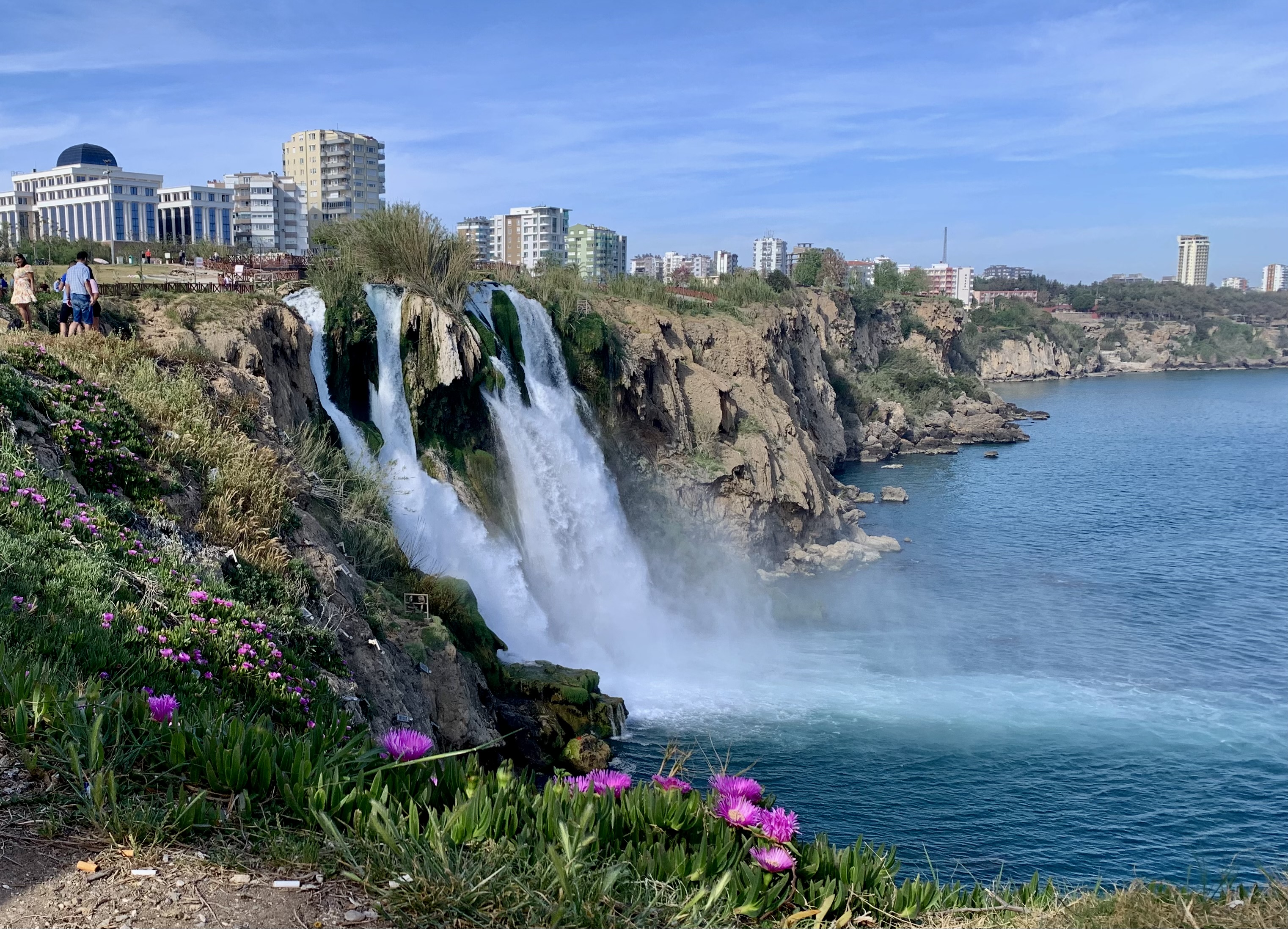
Düden Waterfalls, about a mile from our apartment


Friday, April 29, 2022

Exploring Mallorca

Ted. Judy and I met Monica last April in Costa Rica. She and her friend, Anna were celebrating their completion of medical school back home in Barcelona. On parting, we promised to meet again in Barcelona in October where we were to board a ship back to the US. Monica picked us up at our hotel there, along with our friends Terry and Sue and we had a wonderful evening together. 

Upon learning that we planned to visit Mallorca this month, Monica immediately made plans to travel there herself to spend a few days with a friend from medical school who was born and raised on the island. She informed us that Carme and she would pick us up at our hotel and give us a custom tour. Carme’s family has lived in the town of Manacor as far back as anyone can remember and they speak Mallorquin, the island variant of Catalan. The Nadal family is another old Manacor family and yes, tennis star Rafael still lives there. As a typical young Europeans, Monica and Carme speak excellent English. We learned a lot from the two women as they discussed politics, culture, medicine and careers. They are both very intelligent, well spoken and passionate. We had coffee in Valldemossa, drove the hills past Banyalbufar and enjoyed lunch in Estellencs before winding our way back to Palma. Here are a few of the snapshots capturing a day we will not soon forget.

Carme, Judy & Monica


Thursday, April 28, 2022

Palma de Mallorca

Ted. Before Judy and I left Spain, we wanted to explore one more part of the country that we had never seen. During our last week, we flew to Palma on the island of Mallorca. This is the largest of the Balearic Islands, which lie in the western Mediterranean Sea about halfway between Barcelona and Algiers, Algeria. 

Once again, the history of these islands is pretty bloody. To the list of the usual suspects; Phoenicians, Romans, Byzantines, and Moslems, one can add Catalonians. With the “reconquest” by James I of Aragon in 1229, most traces of previous occupants were wiped out. 

James I of Aragon

Last remnant of the Moslem culture -the Arab Bathes


Most of the folks who settled on Mallorca after 1229 were, like James, Catalonians. Consequently, Catalan remains the main language here and I use Catalan spelling for places. Oh – I asked about the alternate spelling, replacing "ll" with a "j" and was informed that “Majorca” is only used by English people. So there!

On the site of a mosque in the capital of Palma, James I initiated construction of what would become the Catedral de Santa María de Mallorca. Rather plain from the outside, we were stunned by the colors that filled the vast interior. With one of the tallest naves in the world (144 feet), I had trouble fitting all three levels of windows in a single photo. 


The next king, James II was also a busy builder. In 1311 he initiated construction of the first circular castle in the world, Castell de Bellver on a hill overlooking Palma.

No - I didn't get a drone


There's an interesting connection to the USA here. We learned that the 18th century Franciscan missionary, Junípero Serra is from Mallorca. For those of you who have not been to California, he is famous (or infamous) for founding a string of missions along the Pacific coast.

Junípero Serra at Franciscan Basilica

We enjoyed Palma but were absolutely enchanted by the island once we got outside the city. Let's leave that story for another day.

View of Palma from the Castell de Bellver


Sunday, April 24, 2022

Semana Santa

Judy.  I’ve been wanting to see Semana Santa, or Holy Week, in Spain since our Spanish family first told us about it twenty-five years ago. They live in Seville, but Semana Santa is honored in many parts of the country, particularly in the south. So when Ted said we were spending Easter in Málaga, one of the cities where it’s celebrated, I was thrilled. 

One of many Marias


Semana Santa is not like anything I’ve seen before. For a week various cofradía, or religious brotherhoods, parade through the streets for hours with tronos (floats) of precious metals, candles, and religious statues, often carved centuries ago by famous woodcarvers. The tronos carry scenes of Holy Week—the ride into Jerusalem, the Last Supper, Jesus being beaten and taunted by Roman soldiers, Jesus on the cross, being taken down—and almost always, His suffering Mother, dressed in elaborate robes, surrounded by flowers and candles, with hands reaching out in blessing. Up to 250 “men of throne” carry the floats, which can weigh up to five tons. They are accompanied by one or two large bands playing religious music, or by drummers who beat slow, solemn dirges. There are also hundreds of penitentes, dressed in long robes and pointed hats that cover their faces. And, no, they have no association with the KKK. These processions have been going on for 500 years or more. 

Carrying the trono


Mary & John & the Crucifixion


Note his bare feet. They walk for hours.


As Ted pointed out in Antequera we saw the Spanish Legion singing to and carrying a small trono of Christ. Here the soldiers arrive with pomp at the port, march several miles to the Meta Brotherhood, march around with a statue of Christ on the cross, called "The Good Death", then march through the streets escorting the float once the statue was placed on it.

"Il Cautivo" is one of the most beloved figures


I was a bit surprised by the atmosphere during the processions. While there was adoration, it was also something of a joyful street party, which was actually quite nice. Of course there were moments when the crowd went quiet, but most of us were dashing from one parade to another. There might be seven or eight processions in one afternoon and evening.


Trono being carried into the Cathedral 


Penitentes going into the Cathedral

There’s far too much to explain here, and I’m still learning. A prisoner is released on Holy Wednesday in the Bishop’s square. Children are often dressed as penitentes, and some adults who are dressed in the capriotes (cloak and hood) seem to be more like much-needed stage managers. I was surprised at the number of women, who were allowed to join the cofradías back in the ‘90’s. The streets are packed with people, especially since this is the first one in two years. It can be overwhelming. 

Children in the procession of Il Cautivo


I went most evenings, but Ted chose to watch most of them on television. If you want more information, go to Wikipedia and type in “Holy Week in Spain”. Or check out YouTube. It’s fascinating!

On Good Friday, there is a solemn procession of "Sepulcro"


"Sepulcro"


Semana Santa is an experience I won't soon forget. I found myself alternately thrilled, exhausted, charmed, and humbled. There is a mystery to it, as there is in so many religions. I don't really understand the depth of all of it, but I am blessed by those who choose to take part in one way or another. And I am so glad I was able to see it.