Wednesday, March 13, 2019

From the Route of the Stars to Shaking of the Earth


Judy. One of my yoga teachers in Atlanta is originally from Chile. When I asked advice about where to visit when we came here, she had suggestions from the Altacama Desert in the north to Patagonia in the south, and all points in between. Several women I’ve met in Santiago have summer homes further south where it’s cooler, and have had even more suggestions. If we had a year, maybe we could do all that, but time and budget limited us to the six weeks in Santiago, a two-day trip by bus to Valparaiso, and a four-day trip to La Serena.

The main reason for La Serena was that friends from our repositioning cruise, Sylvie and Gilles, are on a South American cruise, and would be stopping there, so meeting them was a no-brainer. Besides, it’s the second-oldest city in Chile, and the gateway to the Valle de Elqui, home of pisco (brandy), observatories, and stargazing.
Traveling the Route of the Stars

 We flew into La Serena and immediately rented a car to drive up the Valley. We’d been told that the drive was a bit dangerous—winding roads and tourists that stop at overlooks and then pull out without looking. Maybe it’s because we just missed tourist season by four days, but the drive was a breeze—and beautiful.

The Valley itself is lush and green, filled with grape vines, trees, and a few other crops. In some places, especially at the beginning, it’s pretty wide, but as you drive, it narrows considerably, and the dry, treeless, cactus-covered mountains begin. It’s such a strange contrast! Much of it reminded us of the Atlas Mountains in Morocco, except for the verdant crops and river below.

Desert cactus
Green valley


The Elqui has a reputation as a mystical place, and some shops offer Tarot readings, tours to alien sightings, and chakra balancing. It lends itself well to such speculation, because it’s like entering another world, and evidently the petroglyphs in part of the valley look like aliens. The mountains press in so closely that it can feel either oppressive, or enlightening. Yes, I know that makes no sense. But at night, when the stars come out and the Milky Way pours across the sky, you do feel as though you could be lifted up and carried away. Astronomers gather in several places, and observatories are scattered along side and on top of the mountains.
The river below


Across the valley
The valley is also home to several pisco distilleries. Pisco is a brandy made in Peru and Chile (the countries argue about who made it first or best—I think Peru wins) that can knock you on your backside. I’d had pisco sours—the national drink—in Santiago. No big deal. Our hostess offered us each a drink upon our arrival, and it was a whole different ball game. We had to take a nap afterwards!

We stayed in the town of Pisco Elqui, and our first dinner was in a courtyard restaurant, lit only by candles and later a fire pit. From there we could watch the stars begin to peek out. On our walk back to the hotel, we kept stopping to stargaze.

The cabañas of our hotel were located in gardens on the side of one of the mountains. It made for wonderfully quiet and private cabins, as you had to climb up and down sets of stairs to get to them. At night from the pool area, you had a full view of the Milky Way, Orion’s Belt, and the Southern Cross. We sat for ages just looking, and I found myself getting up in the night to look out our large windows just to see it all again. Well, and go to the bathroom.
 
Gardens at the hotel
Our cabaña


We had planned to visit an artisan’s village and a pisco distillery, but the village was slowing down (the season was just over) and few shops were open, and the distillery was too expensive for our blood, especially since Ted couldn’t taste the liquor and still drive the winding roads. Instead, we drove down to the next town, Monte Grande, to visit the museum of Gabriela Mistral, Chile’s first Nobel Prize winner, and a teacher of Pablo Neruda, the second. The “museum”, which cost about $1.50 to visit, consisted of the schoolroom where Mistral taught, her room, and some of her original manuscripts of poetry with corrections, as well as photos and copies of the Nobel Medal. Compare that with the three Neruda elaborate homes, which cost about $12 each to visit, and concluded with a gift shop. There I was able to buy a Spanish/English copy of one of Neruda’s volumes; there was no bookstore for Gabriela, and I’ve not been able to find her work translated to English. Both were ambassadors, both lived in other countries, both were Nobel Prize winners in Literature for their poetry. I’m not really sure if or why their legacies seem so different. At any rate, it was humbling to see the tiny school and room where this great poet worked for awhile.
Gabriela Mistral statue in Monte Grande
Pisco grapes

The rest of the day we wandered a bit in Pisco Elqui, but there wasn’t much there. I found it interesting that there were murals of India and shops selling East Indian clothing. I guess that’s part of the mystery. Still, sitting in our cabaña or on our patio, or up by the pool to watch the stars, we felt restful and happy.

The following day we drove back to La Serena and turned in the car. We had a great hostel/hotel in the middle of the colonial area. Again, there was a long patio and garden leading to the rooms, kitchen, lounge, and three outdoor seating areas. So very comfortable to return to after a day of sightseeing!

Courtyard in La Serena

A few months ago there was an earthquake in La Serena—about 6.7 on the Richter scale, and four years ago, an 8.5 hit. Fifteen people died and there was a fifteen-foot tsunami. In Latin American countries there are temblors, or “earth rumblings”, and sismos, or big quakes. The ones a few months ago and four years ago were considered sismos, and people were killed. The receptionist in our hotel didn’t speak English. As we were checking in and struggling through in Spanish, her eyes suddenly got big and she froze. We didn’t know what we’d said to offend! Then she took a deep breath and said, “Temblor!” Somehow we never felt a thing.
Advice after a seismo
As we saw in Oaxaca, there is still damage to some of the older buildings from former earthquakes. Some buildings were closed, others had barriers around them so no one could be harmed in case of falling bricks. There are some absolutely beautiful old colonial buildings, and churches on every corner. This was a rich town once! Down a main road is a long park, called by natives “The Street of Naked Butts,” because of all the Greek statues there! How can you not love a town like that?

That night there was a free concert in the Plaza de Armes, two blocks from our hotel, in honor of International Women’s Day. Local women were recognized and honored, and Maria Jose Quintanilla, a famous singer performed. The crowd—and it was packed—were happy and well behaved—lots of dancing! My favorite were the abuelas who made those standing in front of their bench move out of the way so they could see. When we left, one was standing on the bench and they were all shaking their shoulders.
Gathering for the concert


The following day we took an Uber to Coquimbo, a port town nearby, to pick up Sylvie and Gilles from their ship and spend the day in La Serena. We mostly talked, but also wandered around the colonial area. Sylvie and I scored some earrings while Ted and Gilles sat and talked.

With two of our favorite people
Our Uber driver, Hugo, who took us to pick up our friends, brought us back to La Serena and then met us in the afternoon to take us back to Coquimbo so Sylvie and Gilles could return to their ship. On the way he pointed out a few things, including a sea lion basking on the shore!

Leaving our friends was tough, but more and more often we are keeping up with the people we meet who are important to us, and our community is expanding throughout the world.

Hugo is an Argentine immigrant who arrived in Chile four years ago with two bags and a faith in God. Now he’s married to a Chilena, honeymooned on a cruise, and is making a good life for himself and his wife. It was uplifting to talk to him. He insisted we take his number and let him know if we go back to Argentina. His family, he says, would welcome us to Mendoza.

That evening there was a women’s march in honor of International Women’s Day. Thousands of women paraded down a street near our hotel in a noisy and joyful event. I watched for a while, and never felt unsafe in the crowd.

The excitement of spending the day with Sylvie and Gilles, and seeing the parade kept me awake that night. Some of the march participants returned to a bar near the hotel and were pretty noisy. I was reading and Ted sleeping when I heard a dull roar and the room shook a bit. Yeah. It scared me. The noise from the bar stopped, and when the shaking stopped, there was a great cheer. Crazy!

On the day we left, we mentioned the temblor to another receptionist. Yes, she told us, it was a 4.4. But earlier in the day, there was a 5.2.  We never felt a thing during the day! Ted says he doesn’t know if he felt the nighttime one or my hand grabbing him. By the way, I got back to sleep. He didn’t.

Turns out, this is a hotspot for earthquakes, and there have been several in past years, causing severe damage and tsunamis. All part of the Pacific Ring of Fire, I suppose. We had a taste in Mexico as well. But it’s what to expect here, and it’s not stopping us. Life is too much fun to worry about it.

Sunday, March 10, 2019

Women's Day

Judy. Okay, this will sound strange coming from a feminist, but, while I’m aware of International Women’s Day, the only place I recall seeing much about it is from my (mostly) feminist friends on Facebook. So on Friday in La Serena, I was pleasantly surprised to see how much women were celebrated!

Thursday evening a concert was held in the central plaza and women from all walks of life were honored. There were pilots, EMT’s, farmers, fisherwomen, firefighters, businesswomen, and many others, brought onstage while a huge video screen named them and their accomplishments. Each woman received a trophy and a bouquet. After that, one of Chile’s star singers, Maria Jose Quintanilla, performed for over an hour. The joy for me, though, was watching little girls singing along, and grandmas dancing. The park was packed, and we felt pretty darned special.
Celebrating women in La Serena

On Friday we met up with our friends Sylvie and Gilles and spent the day walking the city. When we stopped for a coffee, Sylvie and I were each given a chocolate and wished a happy Women’s Day. At lunch, our waiter greeted us with “Happy Women’s Day!” I don’t remember that happening before.

That evening, from our hotel room, I heard drums and went outside to see a huge parade of women marching through the streets. I walked with them for a bit—there were thousands of women. As you’d expect, there were all sorts of banners, from freedom to walk at night without fear, to anti-domestic violence, to need for more education, to photos of women who have disappeared, to lesbian rights, to signs proclaiming “FEMINISTA”. There was even a group of local communists carrying flags, and a few Indigenous women carrying their flag. And here’s the thing: It was absolutely joyous. No one was angry; they were all proudly supporting their causes as women.
In honor of the "disappeared" women of La Serena

 
That night I thought about all the remarkable women in my life, in particular, those I’ve encountered in this past year.

Of course, there are my daughter Leslie, and my belle fille Sarah, two excellent mothers who also use their professions to help others, and both of whom I’ve seen hold up other women when needed, including me. They always inspire me, as do my nieces, Kelly, Jenny, Cindy, and Becky, who've welcomed us into their homes, and shown us strong women who manage to balance work and home life.

In Spain, there’s Inmita, who, despite her busy work schedule and her job as wife and mother, finds time to make Ted and me feel like family. In France, and here in Chile, the women in my Bible study group have welcomed me, and shown me the deep love they have for each other as they share their joys and concerns. Sandri, from our intercambio group in the Canary Islands, emails periodically to see how we’re doing. Michaela, our Swedish friend with whom we’ve met up everywhere but Sweden, introduced us to her parents who invited us to their home in Nice, and later flew to London to spend a few days with us. Anya in Poland bravely invited me to her Bollywood dance class, where the women welcomed my funky attempts—without laughing. Sam, our hostess in Morocco, who made sure we were safe and still checks on us, and Linda, our Peace Corps friend who met us in Morocco to share adventures before she returned to the States, opened my eyes to deeper understanding of ancient cultures. Dilyana, our niece in Budapest has an infectious love of life and great business sense, which makes her online German classes fun and effective, and time with her an absolute delight. Mary Jo and husband met us in a restaurant in Nova Scotia, invited us and our friends to spend the night, then met us later in Croatia.

Kay and Susan always offer their guesthouse to us when we return to Georgia, and feed us at least one meal. Carolyn, a friend for years, carves out time for margaritas and girl talk. Sally and her husband back home always have us over, and even met us in Canada for a road trip. Karen in Atlanta catches me up on what’s happening in the theatre, and Roberta has become a friend as well as our incredible financial advisor. Emma, a former neighbor, makes sure we know about cultural events when we’re in Atlanta, and shares her dreams of living in Barcelona. Anne and her husband welcome us every year to their home in Florida, and this year, three other friends from high school, Anne, Linda, and Kathy, came down for a reunion. And dear Sylvie, whom we met on our repositioning cruise, makes me laugh and find the joy in all things.

My Facebook friends keep me engaged with love, encouragement, and laughter.

This year, I lost one of my dearest friends, Karen M. I’ve seldom known a more loving and unselfish person in my life. I miss her joyful outlook, her love for her husband, family, and pups, and her encouragement. When I get back to Georgia, I’ll wrap myself in the afghan she made for me and feel her love and strength.

Of course, I have more women friends—I tried to keep this post about women I’ve spent time with during the past year. If I've missed you, please know that I know more fantastic women than I can begin to name. And I celebrate you all. Thank you for being there for me. May I always be there for you. Belated Happy International Women's Day!

Friday, March 1, 2019

Valparaiso


VALPARAISO
what an absurdity
you are,
how crazy:
a crazy port.
What a head
of disheveled
hills,
that you never finish
combing.
Never
Did you have
time to dress yourself,
and always
you were surprised
by life.
                                                                        --Pablo Neruda
                                                              
Judy. This translation of Neruda’s Ode to Valparaiso, a town he loved, sums it up. It’s definitely not like any place we’ve been before, though we kept trying to come up with comparisons.

It certainly couldn’t be more different than Santiago, our base in Chile for six weeks. (More on Santiago later—we’re still there, just had a couple of days in Valparaiso.) Whereas Santiago is all business and clean streets and orderly life, of a sort, Valparaiso is a dirty, graffiti-filled, hard-working port city. It’s also an artists’ colony, noted for its street art, artists selling their creations in corners of the myriad winding streets and staircases, and expensive little shops in ramshackle but colorful houses. Housing for tourists offers either expensive boutique hotels or not-much-less-expensive hostels. You can eat fabulously tasty take-out empanadas for $6 or a fish and salad lunch in a crazy-busy restaurant for $48. On thing is for sure, you don’t know what to expect next. For example, when we returned, we discovered our hotel was built on the land where a friend's grandmother grew up.

To be honest, we were only there for two days and two nights, so our observations come from instinct as we walked around, and from our guide on the Tours for Tips Walking Tour. But all of it confirmed Neruda’s love poem.

We were told not to expect much from the bus station, but that once we got into town, we’d see its charm. Our hotel was located on Cerro (hill) Concepción, in the heart of murals and tourists, although we didn’t see that many tourists. On our second night, during this, the high season, there were only three other guests, although each day we saw folks wandering around looking at the murals and views from the nearby overlooks.
 
Not so steep stairs near our hotel
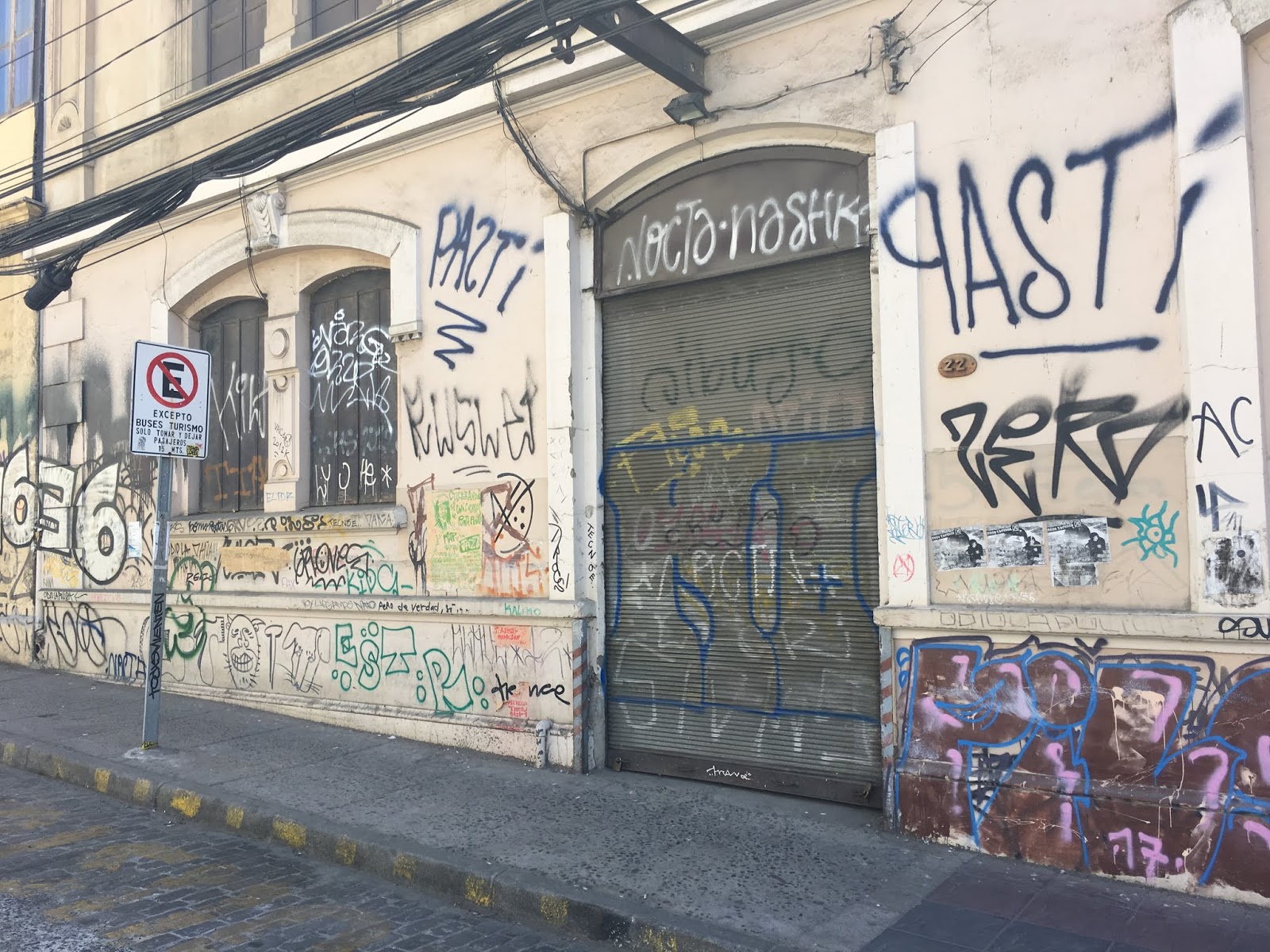
To get almost anywhere required several flights of steps down or up painted walls and stairs. Steep stairs.  Valparaiso is built on forty-three hills, and uses every one of them. When you got to the bottom of all those stairs, the murals give way to graffiti and tagging, and a short walk takes you to Plaza Sotomayor, one of four “main squares.”  See what I mean? No rhyme or reason to the city.
Tagged buildings in the port

The port itself is ugly, and cruise ships don’t dock there. Rumor has it that the unions demanded a raise for unloading freight and cruise ships, so the ships moved to San Antonio or La Serena, further up the coast. I don’t know. I do know that an earthquake destroyed much of the city in 1906, and that in the following years there were fires and floods. Maybe that’s it. Definitely, the opening of the Panama Canal in 1914 delivered the death knell. The Naval Headquarters and some national government buildings are located there (a move made after the restoration of democracy), so maybe that has something to do with it.
Macarena by some colorful doors
Our city guide Macarena, who has lived in and loved the city since she was twelve, told us that the porteños, as the citizens are called, are “crazy.” She says that they hate change, and that’s why all the buildings are falling apart. The government and the citizens want it to stay the way it is. There was a McDonald’s once, but it was burned down. There is not only a resentment of northern hemisphere capitalism, but also the distaste of anything “different”, so there are no chain restaurants or department stores, just mom and pop outfits. There’s something to be said for that. And yet there’s a Starbucks in Plaza Sotomayor and outside of town, a new mall. 
Part of a political mural decrying the Catholic Church and McDonald's

Acensores, or funiculars, once covered the city, but many of them caught fire, so the remains were torn down, and now there are just scars on some of the hillsides. Macarena says there are lots of fires. And that the fire departments were originally started by other countries. US, English and German citizens bought the equipment.
Streets themselves are made of brick, and sidewalks are narrow. Buses are filthy, and we rode on the oldest trolley bus still working. It was built in 1947.

A trolley bus as old as I am!
There’s an Anglican Church located a block from a Lutheran Church. The Anglican was built first, before there was freedom of religion, and the Catholic Church allowed it only if there was no steeple or bell, the doors were small, and stained glass windows were narrow, so as not to outshine any of the large Catholic Churches. It’s a little jewel box of a church. The Lutheran Church was built a couple of years after permission was granted, and it has a steeple and bell.

Definitely steep stairs
And yet. And yet. This insane city has a charm all its own, and street art to lift its spirits and cover the tags. In theory, the murals were illegal (a remnant of the Pinochet government), but if you get permission from an owner, you’re okay. Or if it’s public and no one catches you. We never even saw the police. In fact, now some world-famous street artists have beautiful murals all over the city.
Starting a new mural

Part of a mural by Cuelli


Porteños are creative in other ways, too. Because of the lack of trees, houses had been built of adobe before the earthquake, Obviously, that didn’t fare well. So afterwards, they began repurposing the corrugated metal that had been used to package arriving cargo. Unfortunately, that could rust, so they used leftover paint from the fishing boats—marine paint that would protect the metal. That meant they used any color available, resulting in vibrant colors in the houses as well as on the murals. Soon it became a choice rather than a necessity, and the hills are dotted with blue, yellow, orange, red, or green homes. Some owners have built “toppers” to their houses so they can see the bay over the hotels that hid the view.
Corrugated wall

La Sebastiana

City and bay from La Sebastiana
Standing in the living room of “La Sebastiana,” Pablo Neruda’s home in the hills of Valparaiso, you can easily see his loving description of this crazy port town. And somehow that worms its way into your heart.
View of part of the city from La Sebastiana


Getting to Valparaiso isn’t easy, unless you take a bus from Santiago. It doesn’t seem to be on the way anywhere. You go because you want to—because you heard stories about stops there during the California Gold Rush, or because Isabel Allende writes about it, or because of the mystery. Should you go? Sure. It’s sort of San Francisco weather with Lisbon hills. But it’s not really like anyplace else on earth. And why would you want to miss that?