Wednesday, April 5, 2023

Outback road trip

Ted. One of our objectives during our stay in Adelaide was to venture north to get a small taste of the outback; specifically a taste of a beer in an outback pub. 

The state of South Australia is huge; about the size of Texas and New Mexico combined! The bottom third has a fair amount of moisture and a pleasant Mediterranean type climate. This is also where the vast majority of it’s 1.8 million residents live. However, we wanted to tippy toe into that northern bit that is basically all desert. 

Our target was the old copper mining town of Blinman - population 43. It’s 300 miles due north of us, and the trip took about seven hours. There are no freeways. It’s just two lane blacktop going through every small downtown along the way. As we headed north, we quickly left the suburbs of Adelaide and found ourselves in wheat country. This was where many of the first settlers came, back in the 1840’s. 

Soon we crossed the Goyder’s Line. North of here, the annual precipitation is less than 10 inches so crops should not be grown. This was sheep country and one measures the land, not by how many sheep can live on an acre but how many acres it takes to support one sheep. This is a hard land and most farmers didn’t make it. One man we met had an ancestor who had to sell a 6,000 acre station (ranch) because it was too small to be profitable. Every few miles we’d spot an abandoned farmhouse. 


The towns we met were tiny and typically featured a hotel/pub, a cafe, a general store, a public toilet and, if we were lucky, a gas station. 

Melrose sits at the base of Mt Remarkable

We saw lots of red kangaroos, wallabies, wallaroos and emus. They tend to wander onto the road at dusk, posing a serious hazard to driving. The most common vehicle here is a pickup truck with a heavy grill on the front to protect the fender when local wildlife is eventually struck. 

Wedge tailed eagle pays his respects


Before long, we entered the Flinders Ranges which is a series of low mountain ranges with the highest point being 3,800 feet. They are starkly beautiful and ancient. Rocks here date back 600 million years We finally reached our destination and enjoyed tasty steak pies (they were sold out of the kangaroo and curry pies) washed down with the local brew. Dessert was a tart made from quadongs, a plum like fruit that grows here. 


Our local residence was a cabin at a sheep station. Yes, there were sheep and the restaurant was in the old woolshed. This proved to be a good base for more exploration. But that will be a story for another day…

Sunset at Rawnsley Park Station


Monday, April 3, 2023

Adelaide

Judy.  When we decided we wanted to come to Australia again we knew we needed to pick a new city. Both Sydney and Melbourne were absolutely lovely, but it was time to try someplace different. I’m not even sure why we picked Adelaide, but I’m glad we did. 

Our cottage in the "leafy suburbs" in Eden Hills


We’re in the “leafy suburbs” outside the city proper, and, as we often do, found ourselves being busy where we live, not in the city. We did make a couple of trips to the seaside, but mostly hung around Belair Park and the Eden Hills area. Funny thing is that when we realized there was a Fringe Festival in Adelaide, we thought we’d be down there a lot, but somehow we never got around to it, although most of the folks we met told us it was wonderful. 

Last week, though, we headed downtown twice to hit up some of the museums and the Adelaide Botanic Gardens, all of which are free. What a delightful surprise they all were. 

It’s a very walkable city; from the train station it’s about ten minutes to the museums, gathered together in one spot (convenient, eh?), and ten minutes or so past that are the gardens. There are two universities, the University of Adelaide and the University of South Australia, so there are lots of young people downtown, with tons of cafes and a pedestrian mall with shops and more cafes. Trams and busses run up and down North Terrace, and a few blocks over are theatres and a market. There’s a park all around the city, and it’s framed not only by North Terrace, but also by East Terrace, South Terrace, and West Terrace. We spent most of our time around North Terrace and East Terrace. 

Collection of shields from different tribes

Doors painted at a tribal school


The Museum of South Australia is noted for its huge collection of Aboriginal artifacts. It was truly overwhelming; who knew there were so many types of boomerangs? But we learned a lot. 

Nearby is the Immigration Museum, celebrating the diversity of the country. It, too, was well planned, but a bit overwhelming. Until fairly recently, Australia had a “whites only” immigration policy, but once that was opened up, the world showed up. It was touching reading the stories, some of which were not so pleasant. I appreciated the honesty of the museum in recognizing that. A man from Iran was quoted as saying, “Iran is like my mother—I will never forget her. Australia is like my wife—I chose her.” 

Fortunately, a small portion was dedicated to the indigenous populations who were treated so disgracefully; a film showing the dedication of the Colebrook Reconciliation Garden was shown. 

Entrance

Touching sculpture


The building is a new one, but located in a detention area where people were held in quarantine both upon arrival, or if they were single moms or young people. The former maternity ward housed stories of children who were abused, or single mothers who had their children taken away. 

Probably our greatest surprise was the South Australian Gallery of Art. One side focused on Australian art, and the other, on European art, and a gallery in the basement held a collection of Asian (think Indonesian, Indian, and Malaysian works). The curator did a fabulous job in the Australian section of installing Aboriginal artists by white artists, china by sculpture, and furniture throughout. So you might be looking at a landscape painting of the bush and a billabong, and next to it might be a painting by an indigenous artist. Below it might be a table with china on it, and across, a sculpture. Much of it was disturbing, as art can and should often be. It’s a place I’d love to visit again.

Two versions of landscapes

Painting of a bush billabong


Sculpture by an Aboriginal artist

Right in the middle of the city is a large botanic garden, one of three. (The others are Wittunga, near us, and Mount Lofty.) Unlike Wittunga, which celebrates mostly Australian flora, the Adelaide gardens have a bit of everything—succulents, water gardens, trees from all over the world, a rose “test” garden (which ones are the favorites?), a dahlia garden, Mediterranean area, a memorial of thanks to the Americans for helping the country in World War II, even a memorial to Elvis Presley. I kid you not. Our guide was not particularly good, but we sure enjoyed the park. 

Lily pads

I loved this tree-lined path

The Mediterranean garden had familiar plants

This tree, thought to be extinct, was rediscovered, and is thriving!

At the east end of the park is the National Wine Center. As you must know, Australia is noted for its wines, and this huge, modern building has a small educational section, and 38,000 bottles of Australian wines! There were 120 “on tap” to be tasted, but we chose four. Two were quite special, and two okay. 

A small portion of the 38,000 bottles

Great way to try before you buy!

And finally, a lunch at a Middle Eastern cafe recommended by our friend Terrance. It’s called Munooshi, and served, among other Middle Eastern goodies, a folded pizza called munooshi, filled with all kinds of goodies. Ted chose the one with lamb, and I chose the vegetarian option. Absolutely delicious, and worth the two trips it took to eat there. The owners were a sweet family, too. 


Friendly owners, and great cooks!


I know there’s more to be seen in the city of Adelaide. We just didn’t get to do it all.

Saturday, March 25, 2023

Our koala hunt

Ted. One month into our visit to Australia we had not yet seen a koala. We had seen lots of beautiful birds, some kangaroos, a couple of wombats and possibly a wallaby (though it may have just been a young kangaroo). Frankly, we were getting a little tired of everyone telling us they were all around us. “They’re probably in your garden.” “We have two in our yard right now.” “There in the tops of most trees - just take your time and look.” All of these tips simply added to our frustration. 

So, yesterday morning, we rose early and took the train to nearby Belair National Park, determined to spot a koala or die trying (well, that’s an exaggeration). Armed with our binoculars, iPhones and plenty of water we headed out into the bush…what the locals call the woods. Everyone told us to look for a lump in a fork of a gum tree (eucalyptus). Do you have any idea how many gum trees there are in the bush? There are HUNDREDS! And each tree has lots of forks. We probably looked at thousands of forks. There are also knots and bumps in the trees so we inspected all of those. 

The bush

Ultimately, we did spot a suspicious lump. 

Suspicious lump in the fork on the right

Since it was way up there, I resorted to a trick I learned in Alaska and held my iPhone up to one lens of my binoculars. Low and behold, the lump had a face! 

Larry

Ultimately, we saw three of the furry little guys. As you can tell, they weren’t working very hard to elude us. 

Moe


Curly

It was a beautiful day and we enjoyed the hike, spotting a couple of kangaroos and some more types of birds we had not seen before. After taking the train back to the village, we settled into a pub to toast ourselves for a successful hunt. 

We were told along the trail it is also possible to spot echidnas in the park. Maybe we’ll try our luck at more big game on another day.

Thursday, March 23, 2023

Parks

Judy. Near our cottage in Eden Hills, there are two parks, each with much to teach us. 

The Wittunga Botanic Garden is a botanical garden dedicated to plants that grow in this and like regions. It’s well-laid out, and on Tuesday mornings, one can take a tour of the gardens, led by Helen, who quite obviously loves every part of them. The plot was once a farm and orchard, developed by farmer Edwin Ashby in 1902. The name means “beside water”, and it’s situated
Helen points out the Blood Lilies
around a billabong (stagnant pool) and a lake, where water used to trickle from an uphill spring. Ashby was ahead of his time in studying agriculture and plants, so there are some interesting and beautiful species. In the seventies, his son Keith donated the land, along with some of his and his father’s gardens, to the city. 

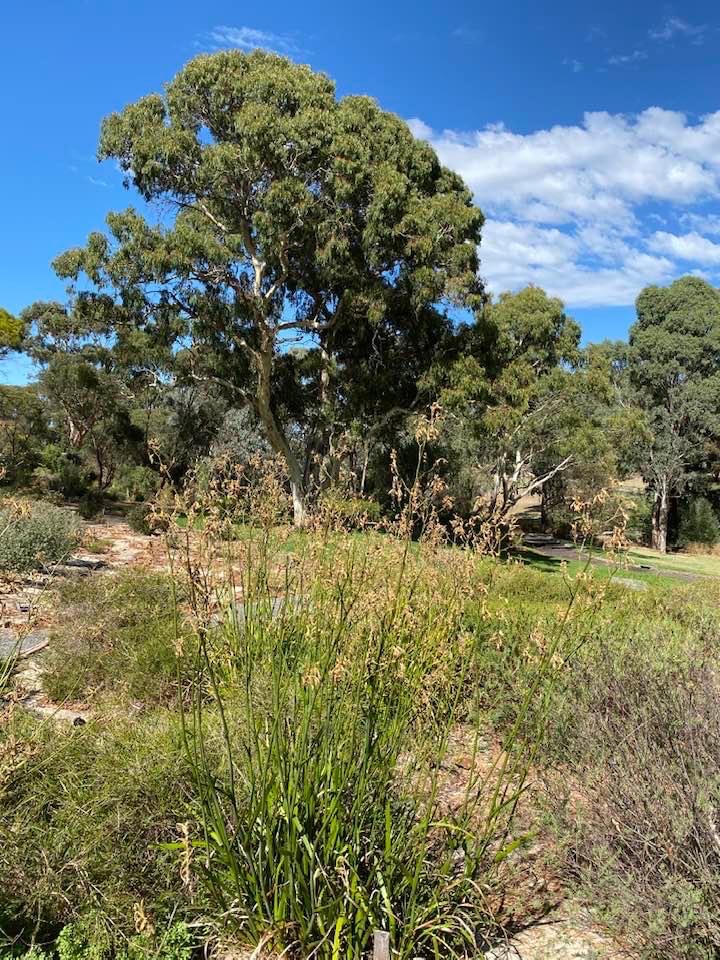
The most imposing part of the park is the number of species of eucalyptus or gum trees. One of the oldest trees on the planet, it has evolved to at least 800 different species! While they’re invasive in Spain and the US, they are welcome here, although they do cause a problem when bush fires happen, exploding like bombs because of the oil in its leaves and wood. Interestingly, the oldest fossils of the eucalyp are found in South America, although the tree no longer grows there. 

Some of the different types of eucalyptus trees


A small part of the garden is dedicated to plants grown in the Fynbos region of South Africa, from Cape Town to Port Elizabeth (a route we took when we were there). It seems they have a similar climate to South Australia, so it’s a good place to showcase plants from that area, like the protea, the iconic South African flower. 

The Fynbos garden


Other areas feature Australian wetland plants, plants native to Kangaroo Island, endangered plants from the deserts of Western Australia, and the Gondwana Trail, which displays ancient plants left in the area when the continent split and drifted apart. It’s a great place to wander, explore, and listen to birds—but not Ted’s dreaded noisy miners! 

A lovely secluded path

About four blocks away is the Colebrook Reconciliation Park. Colebrook was one of those horrible homes where indigenous children, taken from their parents, were placed in order to “anglicize” them, as part of the United Aboriginal Mission. Colebrook itself began in other areas of the state, and was headed by Sister Ruby and Sister Della, who were said to be very kind to the children. In 1953, after it had moved to Eden Hills, a series of strict superintendents took over. From 1943-1972, almost 140 children were removed from their parents, never to see them again. They lost ties not only to their families and ancient customs, but to the land as well. In 1972 the home was closed, and in 1973, the building was razed, but the scars remain. A good movie to get a sense of this is Rabbit Proof Fence.


In May of 1997, local officials of this area issued an apology, but Prime Minister Kevin Rudd’s apology didn’t happen till 2008. Colebrook Reconcilation Park, built on the old location just a few short years ago, was an effort of several groups to remember and honor the “Stolen Generation”. 

There is a heartrending statue called “The Grieving Mother,” with empty arms (someone placed flowers there with the sad note stating that nothing has changed), and a “Fountain of Tears” has water flowing over the faces of Aboriginal elders. There are trees and rocks, and one of the most moving additions is a series of “listening posts”,  painted by local schoolchildren with the help of Carly Takari Dodd, of Aboriginal decent. Press a button and you can hear stories from some of those who lived there. 

Fountain of Tears

The Grieving Mother


A quiet spot to contemplate. Note the "Talking Post" on the left

It’s hard to walk away without tears in your eyes, especially remembering that situations much like it occurred in the US and Canada.

Tuesday, March 21, 2023

Tasmania

 Judy.  When we decided to come to Adelaide, we also decided to take a quick trip down to Tasmania and put a new Australian state on our map.  Last week we packed a few things, took the train to the airport, and hopped a plane to the island state off the coast of Australia.

Ok--truth here: I expected it to be all forests (bush, I should say in Australia), and Tasmanian Devils waiting to chase me down. Yes, I am embarrassed to admit that.

What we found, when we arrived in Hobart, the capitol, was a busy city with charming old repurposed buildings next to modern ones, a port city with plenty of tourists and lots to see.

A very busy Salamanca market


On our first morning we got up in time to visit the Salamanca Market, a "must see" artists' market by the port. We got there pretty early, and it was already busy. Ted took off to a nearby park while I roamed the booths, finally settling on a pair of opal earrings--my version of a t-shirt that proudly proclaims "AUSTRALIA." Much classier, I'd say.


Greg and Ted atop kunanyi

As we finished up, Ted contacted Greg, mutually introduced to us by our friend Carolyn in Georgia. Greg is a former geography and history teacher, and, whisking us off to Mt. Wellington (kunanyi in the language of the Indigenous peoples) pointed out the remnants of the ice age, the trees that grow on the mountain, and, finally, the magnificent view of the city.

View of Hobart 

From there we dropped down to a hotel restaurant by Kangaroo Bay for a delicious lunch before heading into Coal Valley for a taste of the wine country, and finally to Richmond, a lovely old town where early convicts brought into Australia were held and made to work. I was disturbed by the small prison where they were kept, especially by the "solitary rooms." Oddly, Greg told us, while it used to be embarrassing to be descended from convicts, it's now quite chic! They've gotten their revenge! We were enjoying each other so much that we convinced him to stay and have pizza and beer with us at an old pub near our hotel.

Where convicts were held in Richmond


This beautiful bridge was built by convicts


The next morning we took the ferry to MONA, the famous art museum built by David Walsh, who made his money gambling.  Google it--fascinating story! The museum, which is also where he and his wife live, is in an underground building, and houses all kinds of both "accepted" and "controversial" art, from Egyptian mummies to paintings to a "poop machine" (you gotta google that, too) and performance art. Everyone recommended it, and no one could explain it. I can't either, but it truly is not to be missed! Our favorite exhibit was a wall filled with videos of people singing an entire Madonna album. The library was fascinating, too, as was the entire "Abbey Road" studio moved into the building!


Spider webs

Fat car


Monday morning we visited a more conventional museum, the Tasman Museum, for more history; and that afternoon our Servas host, Sonja, picked us up and took us to her lovely home in the suburbs. We had a great evening learning about each other and eating the coq au vin she made for dinner.

One of the things we love about Servas stays is that we fit into the lives of our hosts. Ted did some repairs for Sonja, and we agreed to accompany her to test drive a camper van she was considering. On the way, we stopped at Puddleduck Vineyard for lunch and delicious sparkling wine--what Tasmania's known for. Delicious on both counts, and fun to eat by the pond with a giant duck in attendance! 

The giant duck looks on as we enjoy our sparkling wine


Sonja is a breast cancer survivor and is a member of Dragons Abreast Dragonboat Team. This is a worldwide sport, and I've since learned about teams of women around the world. We went to watch the women practice for a race in New Zealand, and were both filled with admiration for these powerful women--the mean age is 70! Of course we went out for drinks afterward and got to know some of the team members a little better.

Proud to meet these amazing women


On our last morning, Sonja took us and her friend Catherine to Maria Island for more history, some animals, and a great hike. Views were fantastic, watching Ted stalk a herd of kangaroos to get a photo a delight, and the hike invigorating. It was a perfect end to a great visit.


Up close and personal with kangaroos

Fossil Bay

Wombat--which end is which?

The painted cliffs


Sonja drove us to the airport, and we arrived back at our place in Eden Hills about ten that night. We fell into bed, happy and exhausted. And slept nine hours.